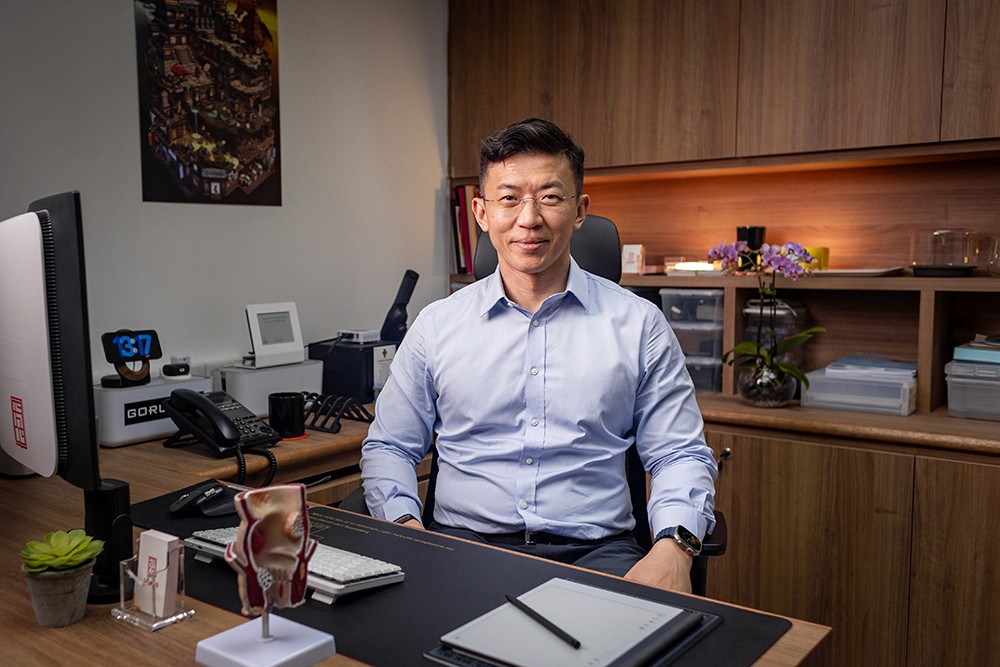
Meet Dr. Loong
Beyond the white coat: get to know your doctor
My path through colorectal surgery has been somewhat circuitous, though I have come to appreciate how each stage has contributed to the breadth of care I can now offer patients.
After obtaining my medical degree from the University of Dundee in Scotland, I had the opportunity to work at Ninewells Hospital, Dundee, alongside surgeons developing minimally invasive techniques. Then, at Edinburgh’s Western General Hospital, I witnessed the early implementation of what is now termed the Enhanced Recovery After Surgery (ERAS) protocol, which demonstrated that surgical outcomes depend on more than just operative technique. And a research fellowship at University College Hospital in London focused on anal pathology, including warts and the early detection of anal intraepithelial neoplasia, helped me developed an evidence-based approach to managing colorectal conditions, as well as an appreciation on what is involved in setting up a highly sub-specialized niche service.
Returning to Singapore, I joined Singapore General Hospital and later Tan Tock Seng Hospital (TTSH). Whilst at TTSH, I worked on quality improvement projects aimed at enhancing colonoscopy performance and reporting, and reducing complications from colorectal cancer surgery. As robotic-assisted surgery gained popularity, at TTSH, we mastered this new technique, particularly for low rectal cancer cases where preserving function is critical. The technology offers genuine advantages in certain situations.
Subsequently, a fellowship at CHU Nantes in France help me develop a deeper appreciation of functional colorectal disorders — conditions such as pelvic floor dysfunction, constipation, and obstructed defecation — that are not traditionally managed surgically, yet can significantly impact patients’ quality of life. This led to me establishing the Colorectal Pelvic Floor Disorder Clinic at TTSH, addressing a gap in care for patients whose problems do not fit the conventional surgical model. My continued involvement in this area is reflected in my membership of the Society for Continence (Singapore), where I remain engaged with colleagues working on these often-overlooked conditions.
Working with the TTSH Nutrition Support Team and the Singapore Society for Parenteral and Enteral Nutrition (SingSPEN) added another dimension to my practice. Nutrition plays a fundamental role in surgical outcomes, cancer recovery, and the management of chronic colorectal conditions, yet it is sometimes treated as secondary to the technical aspects of surgery. I have found that integrating nutritional considerations into treatment planning leads to better overall outcomes for my patients. I currently serve as President-Elect of SingSPEN, a role that keeps me connected to the latest developments in nutritional support and allows me to contribute to raising awareness of its importance in surgical care.
These interests sit alongside my work within the broader colorectal surgery community. As Secretary of the Society of Colorectal Surgeons (Singapore), I remain actively involved in the specialty’s development locally, while my varied clinical focus allows me to contribute perspectives that span surgical technique, functional disorders, and supportive care.
The reason this varied background matters is that colorectal conditions often do not fit neatly into single categories. A patient might present with one issue but have related concerns spanning multiple areas. Someone undergoing cancer surgery may benefit from nutritional optimisation. Chronic symptoms may stem from pelvic floor dysfunction rather than a structural problem, or may be related to nutritional and dietary factors. The choice between robotic, laparoscopic, or open techniques should depend on the specific clinical situation, not simply on what a surgeon happens to be most comfortable with.
What I can offer is experience across these different sub-specialties — robotic and minimally invasive surgery, cancer care, functional disorders, anal conditions, and an understanding of how nutrition intersects with all of them. For patients whose conditions are straightforward and fall within a single specialty area, focused expertise from any competent colorectal surgeon will serve them well. However, for those dealing with more complex or multifaceted issues, or for those who prefer a surgeon able to address related concerns without multiple referrals, this broader training background may be relevant.
When I meet with patients, I draw on these various experiences to consider not only the immediate surgical problem, but also the broader context of recovery, functional outcomes, nutritional factors, and long-term quality of life. This approach emerged organically from a somewhat unconventional training path, and it continues to shape how I practise.
So if you think you have an issue that would benefit from my approach, please contact us to schedule a consultation.